
A Job Search Tracker for Software Developers
Developer job searches have their own quirks: take-home tests, system design rounds, and many similar roles. Here is how to track them well.
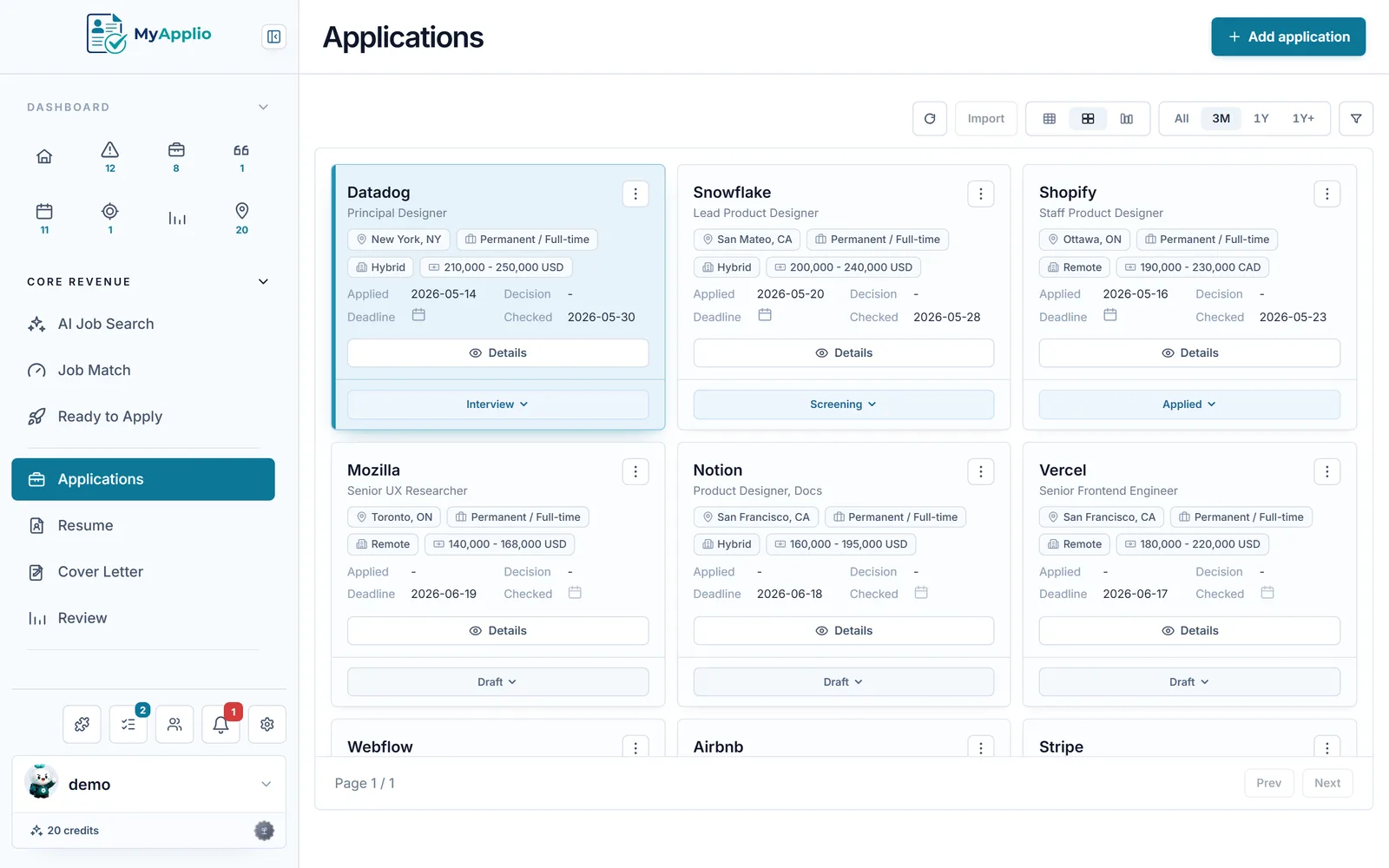
Most job search advice assumes a tidy pipeline: you apply, you wait, you interview, you hear back. For software developers that picture falls apart fast. A single role can run through five or six distinct stages, each with its own homework and its own people. A general-purpose tracker that only knows Applied and Interview loses the detail that actually decides whether you stay on top of the process or let a deadline quietly slip. A job search tracker built around how engineers are really hired keeps every loop, take-home, and compensation note in one place so you can move quickly without dropping anything.
Why developer job searches are different
Hiring for engineers is multi-stage by design, and the stages are not interchangeable. A typical loop might start with a recruiter screen, move to a take-home assignment or a timed coding challenge, then a live technical interview, then a system design round, and finally an onsite or final panel before an offer. Each step can be days or weeks apart, run by different interviewers, and gated on work you have to deliver yourself.
On top of that, the roles look deceptively alike. Twenty "Senior Backend Engineer" postings can mean twenty different tech stacks, seniority bars, and team cultures. Without a place to record the specifics, the applications blur together and you walk into a call unsure whether this was the Go shop or the Rails one. The cure is structure: a tracker that captures the things that vary between developer roles, not just a status label.
The extra fields developers should track per application
A general tracker captures company, role, link, and date. Engineers need a few more columns to make each entry useful weeks later. For every application, record:
- Tech stack: the languages, frameworks, and infrastructure the role centers on, so you can tailor your prep and tell similar postings apart.
- Role level: junior, mid, senior, staff, or lead. Leveling drives the difficulty of the loop and the comp you should expect.
- Take-home status and due date: whether an assignment is assigned, in progress, or submitted, plus the hard deadline.
- Recruiter: the name and contact of your recruiter or point person, since they are who you follow up with between rounds.
- Interview loop stages: which rounds you have cleared and what comes next, so the pipeline is never a mystery.
- Compensation and equity: the posted or discussed base, bonus, and equity, captured early so you can compare offers honestly.
These fields turn a flat list into something you can actually act on. When a recruiter emails after two weeks of silence, you want to glance at one row and know the stack, the level, where you stand in the loop, and what you last discussed about pay.
Pipeline stages that fit developer hiring
Generic stages like Applied and Interviewing hide most of the process. It helps to track each real checkpoint of an engineering loop in the notes and details you keep on each application:
- Saved: a role you want to apply to but have not yet.
- Applied: submitted, waiting on a first response.
- Recruiter screen: the intro call about scope, level, and comp.
- Take-home: an assignment or timed challenge is in flight.
- Technical: a live coding or domain interview.
- System design: an architecture or design discussion, common from mid-level up.
- Onsite / Final: the full panel, virtual or in person.
- Offer: terms are on the table.
Seeing your applications spread across these stages tells you where your search is healthy and where it stalls. If five roles sit in Take-home and nothing moves to Technical, your assignments may need more polish. If everything dies at the recruiter screen, the problem is upstream in targeting or resume fit.
Tracking take-homes and timed challenges so deadlines do not slip
Take-home assignments are where strong candidates quietly lose offers, not because the work is hard but because the deadline arrives unnoticed during a busy week. Treat every take-home as a small project with a fixed end date. The moment one is assigned, record:
- the exact due date and time, including the time zone;
- your honest estimate of hours required;
- any constraints, such as a strict time box or a banned library;
- where the prompt and your submission link live.
Timed coding challenges, the ones you start and must finish in ninety minutes, need a different note: block real, uninterrupted time on your calendar before you open the link, because you cannot pause once it begins. Sorting your tracker by due date turns a pile of assignments into an ordered queue, and a clear view of what is due next is the single best defense against a missed deadline. This is also where a dedicated a job application tracker earns its keep over a spreadsheet: it can surface what is due soon instead of waiting for you to remember to look.
Preparing for the interview loop
Once a role reaches the technical and system design stages, preparation becomes role-specific. This is exactly why the tech stack and role level fields matter: prepping for a Kubernetes-heavy staff role and a front-end mid-level role pull in opposite directions. Use what you recorded to focus your study time rather than grinding everything at once.
Keep a short prep note per active application. For each upcoming round, jot the interview format, the names of your interviewers if you know them, and two or three topics likely to come up given the stack. Rehearse the common patterns and review a set of interview questions that match the level and domain so the live round feels like a conversation, not an ambush. After every interview, write a quick retrospective while it is fresh: what they asked, what you fumbled, what to tighten before the next loop. Those notes compound across a search and make your fifth onsite far sharper than your first.
Keeping it all in one workspace
The point of a job search tracker for software developers is not more admin, it is less anxiety. When the stack, level, take-home deadline, recruiter, loop stage, and comp all live in one row, you stop holding the process in your head. You can run more applications in parallel without confusing them, respond to a recruiter in seconds instead of reconstructing context, and walk into each round knowing exactly which company and which stack you are facing.
Developer job searches will always be messier than the linear pipeline the advice columns describe. Take-homes overlap, loops stall, and similar roles pile up. A tracker you keep tuned to how engineers are hired, with the statuses, fields, and notes that fit the loop, will not make the search short, but it will make sure nothing falls through the cracks while you are doing the real work of landing the offer.
Put this into practice for free.
Capture jobs in one click, tailor your documents, and track every application in one workspace.